

Pranay Gupta (Junior Generative AI Engineer), Simran Bajaj (Junior Agentic AI Engineering) | 09/12/2025
The Problem: When Access is a Luxury, Not a Right
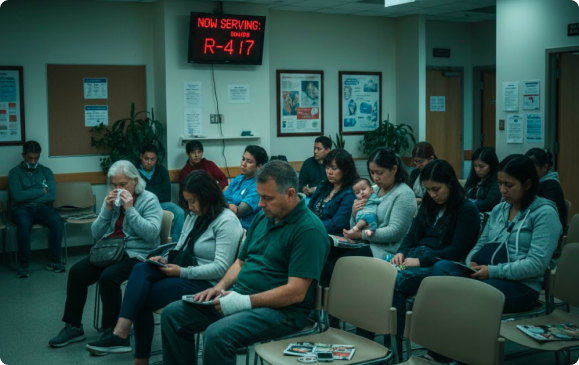
Imagine this. You live in a small, rural town let’s call it Oakhaven. The nearest primary care doctor is 50 miles away. You wake up with a burning sensation and constant urge to go to the bathroom. You suspect a simple Urinary Tract Infection (UTI), but to get a diagnosis, you face:
- The Time Sink: A two-hour round-trip drive.
- The Wait: Sitting for another hour in a crowded clinic waiting room, possibly exposing yourself to other illnesses.
- The Cost: Gas, time off work, and the co-pay.
This is the grim reality of healthcare access a problem of timeliness, equity, and efficiency (Source 3.3). For the nearly 20% of the US population living in rural areas, and countless others worldwide, this travel and wait time can turn a minor ailment into a serious complication and make essential periodic health assessment or chronic care management nearly impossible (Source 2.2, 3.2).
The question is: How can technology eliminate the 50-mile gap and the two-hour wait?
The Solution: Introducing the Virtual Digital Doctor
The answer is the Virtual Digital Doctor. This isn’t just a basic video call; it’s a sophisticated, AI-powered system designed to triage, diagnose, and manage your care using advanced technology.
Let’s watch our Oakhaven resident, Sarah, interact with a Virtual Digital Doctor platform called “KlinIQ Ai.”
Scenario 1: The AI Symptom Checker – Immediate Triage
Instead of driving, Sarah logs into her virtual doctor appointment app.
- Symptom Input: An AI symptom checker prompts Sarah. “Tell me about your symptoms.” She types: “Burning when I pee, constant urge, feel run down.”
- AI Reasoning: The system, using sophisticated agentic reasoning AI doctor protocols, cross-references her symptoms with millions of clinical cases. It asks key questions a human doctor would: “Any fever? Back pain? Have you had a UTI before?”
- Decision Support: The clinical decision support system (CDSS) quickly flags the symptoms as highly likely to be a simple UTI, not a more dangerous kidney infection.
- The Result: Within 5 minutes, the AI triages her: “Low risk, likely UTI. Connecting you now to an on-call virtual doctor for confirmation and prescription.”
Interactive Moment: Quick Diagnosis!
If you were Sarah, how much time and stress would this initial 5-minute interaction have saved you compared to calling a clinic or driving 50 miles?
Hint: Research shows virtual visits can reduce wait times from weeks to hours, and in one case, from weeks to mere minutes for certain conditions (Source 4.4).
Scenario 2: The Scribe in the Room Efficiency for the Doctor
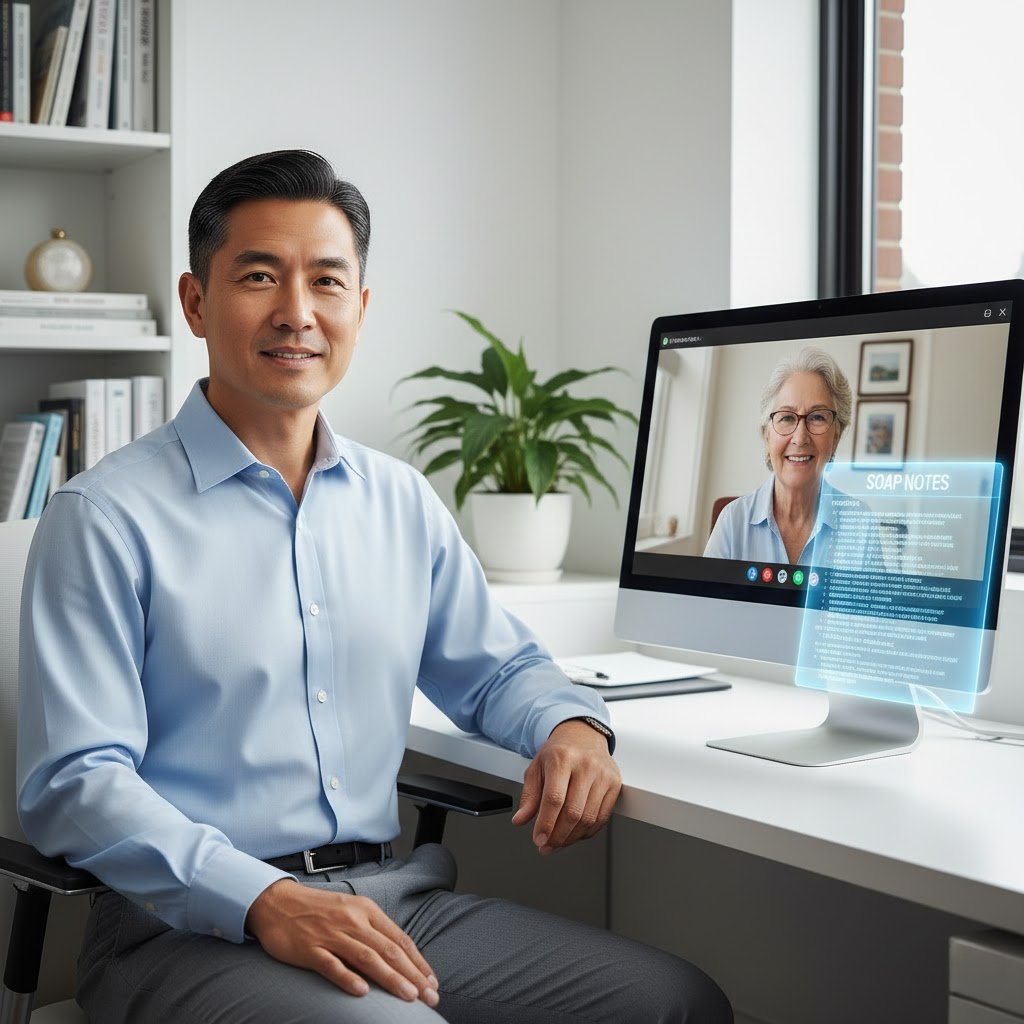
The virtual doctor visit now begins. A human provider, Dr. Chen, appears on the screen.
- Dr. Chen’s Advantage: Dr. Chen is already briefed. The AI medical scribe (a tool like Freed AI Medical Scribe) has already listened to Sarah’s interaction with the symptom checker and pre-populated the digital doctor notes in the EHR.
- The Interaction: Dr. Chen skips the tedious data collection. He focuses on confirming Sarah’s medical history and asking human-touch questions: “How are you feeling about this? Are you stressed?”
- The Power of AI Scribing: As they talk, the AI scribe medical tool transcribes the conversation and automatically drafts the full SOAP notes for doctors in real-time, leveraging the FHIR standards to ensure the data is instantly usable by the lab and pharmacy.
This technology allows Dr. Chen to manage 75% of cases virtually and dedicate his full attention to the patient, rather than the keyboard (Source 3.1).
Fact Check: Scribe Superpower!
A study found that doctors using AI scribes were able to cut their documentation time by over 80%, regaining their work-life balance and improving patient focus (Source 4.3). This is key to reducing doctor burnout and increasing the availability of virtual doctors online.
Scenario 3: Real-World Success Chronic Care in the Comfort of Home
The true impact is felt in chronic care management.
Case Study: The Diabetes Divide Bridged (Source 1.4, 4.1)
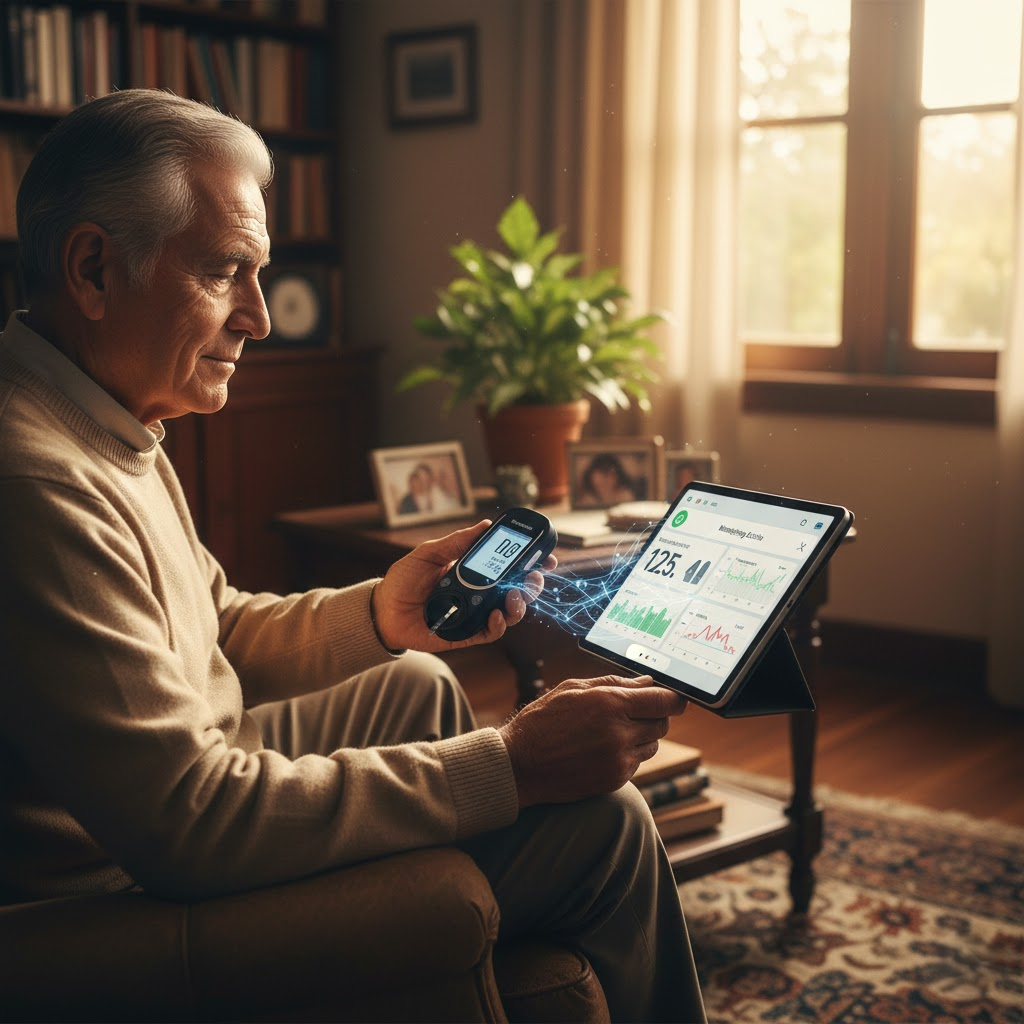
Mr. Rodriguez, an elderly patient living alone, struggles with Type 2 Diabetes. Traditional care meant frequent, costly visits to a far-off specialist to check his HbA1c levels and adjust his medication.
With a Virtual Digital Doctor system, his life changed:
- Remote Monitoring: He uses a connected blood glucose meter that automatically sends his daily readings via FHIR API to his care team’s dashboard.
- Proactive AI: If his numbers spike, the system’s clinical decision support software alerts a human nurse or an AI doctor diagnosis system. It can also automatically send him a reminder via his medication adherence app.
- Virtual Check-ins: Instead of driving for a 15-minute check-up, he has a monthly virtual doctors visit where a specialist reviews his symptoms tracker data and makes real-time adjustments.
The result? Enhanced medication adherence, a significant improvement in his A1c levels, and a substantial reduction in claims costs (Source 1.4, 4.4). This system brought the specialist to Mr. Rodriguez’s home, overcoming the geographical barrier that once dictated his health outcomes.
Conclusion: Beyond Convenience, It’s about Equity
The Virtual Digital Doctor is more than a convenience it is a powerful agent of healthcare equity. By combining the speed of the AI symptom checker with the meticulous documentation of the AI medical scribe, and basing all decisions on real-time data shared via the FHIR interoperability standard, we are creating a system that is:
- Timely: Eliminates long travel and wait times.
- Efficient: Reduces administrative burden on doctors.
- Accessible: Brings high-quality specialty care to rural and underserved populations (Source 2.1).
It is a partnership: AI does the tedious, complex data analysis; the human doctor provides the essential compassion, judgment, and connection.
Here are the source links for the references mentioned above:
Source 1.4 – https://pmc.ncbi.nlm.nih.gov/articles/PMC11298029/
Source 2.1 – https://pmc.ncbi.nlm.nih.gov/articles/PMC11383462/
Source 2.2 – https://www.deloitte.com/us/en/insights/industry/government-public-sector-services/virtual-health-telemedicine-rural-areas.html
Source 2.3 – https://pmc.ncbi.nlm.nih.gov/articles/PMC8232733/
Source 3.1 – https://www.researchgate.net/publication/275660785_Virtual_Visits_-_Confronting_the_Challenges_of_Telemedicine
Source 3.2 – https://pmc.ncbi.nlm.nih.gov/articles/PMC11414145/
Source 3.3 – https://www.medrxiv.org/content/10.1101/2021.07.28.21261021v1.full-text
Source 4.1 – https://www.healthrecoverysolutions.com/patient-success-stories
Source 4.3 – https://practolytics.com/casestudies/the-power-of-a-virtual-scribe-a-doctors-success-story/
Source 4.4 – https://resources.amwell.com/blog/three-telehealth-success-stories