

By Vinotha R (Director – KlinIQ Ai) | 10/11/2025
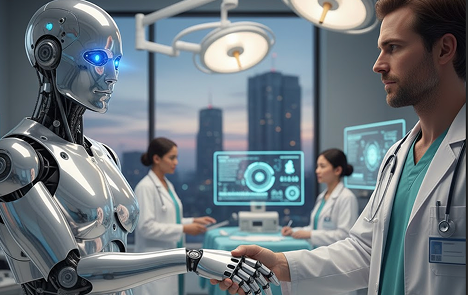
The U.S. healthcare system is standing at a major crossroads. Patient demand is increasing, the workforce is shrinking, burnout is spreading fast, and the cost of care continues to rise. In the center of all this pressure, a new partner is emerging — KlinIQ Ai, not to replace people, but to strengthen them.
The misconception is that AI will take over clinical roles. The reality is the opposite: AI is becoming the tool that gives clinicians their time, clarity, and energy back.
One senior physician put it simply: “I don’t need technology to act like a doctor. I need it to give me space to be one.”
Across hospitals and clinics, doctors and nurses spend a huge portion of their day on work that is not directly patient-facing — chart reviews, documentation, data entry, prior authorizations, reporting. AI steps into these burdens quietly and consistently, allowing healthcare workers to focus again on the part of their job that truly matters: caring for people.
What makes AI’s role in healthcare transformative?
It amplifies human ability.
AI can process medical images, compare years of patient history, and analyze huge data sets within seconds. It reveals patterns that would take a human years to identify — yet every outcome still depends on clinical judgment.
It keeps improving as more data flows in.
Traditional systems stay static. AI adapts. With every new case, it refines its understanding, giving future patients better and more accurate insights.
It makes personalized medicine possible at scale.
From predicting chronic disease risk to tailoring treatment paths, AI can adapt recommendations to the unique biology, lifestyle, and history of each individual.
It works without fatigue.
Humans get tired. They feel stress. They reach their limits.
AI doesn’t. It supports the clinical team around the clock, providing consistency and reliability, especially in high-pressure environments.
It integrates a patient’s entire journey.
Medical history, behavior data, lifestyle signals, genetics, medication patterns — AI can merge all of this into one unified view, something no single clinician could process alone.
AI is not a replacement for medical expertise — it is an extension of it.
AI offers precision, speed, and predictive power.
Healthcare professionals bring empathy, ethical reasoning, compassion, and lived experience.
Together, they create a care model that is safer, faster, and deeply human.
Think of AI as a powerful instrument — and clinicians as the people who give it purpose.
Most importantly, AI offers relief where it is needed most: burnout.
When repetitive tasks no longer drain time and mental energy, healthcare workers feel supported. They have more moments with patients, more clarity in decisions, and more room to recharge. That human restoration is one of AI’s greatest contributions.
The future of U.S. healthcare isn’t a competition between people and machines.
It’s a partnership.
A future where AI handles the complexity so humans can lead with compassion.
A future where technology strengthens the workforce instead of overwhelming it.
A future where both work side by side to deliver exceptional, personalized care.
As one clinician described it,
“AI analyzes the data, but humans care for the patient. Healing always starts with us.”
This next era is not about replacement — it’s about empowerment. It’s about giving healthcare professionals the support they deserve and giving patients the care they’ve always needed.